
BRIDGELAND, Houston, TX*
Bridgeland is an 11,400-acre master-planned community northwest of Houston, designed to accommodate approximately 65,000 residents at full buildout. The project builds on the planning legacy of The Woodlands but introduces a highly engineered environmental infrastructure strategy as the organizing framework for growth.
At the core of the master plan is an interconnected 900-acre lake system serving as both a placemaking element and a comprehensive stormwater management network. The system exceeds local design standards and has successfully managed storm events well beyond projected thresholds — protecting long-term asset value while reinforcing community identity.

It is a successor of the Rouse Company, a pioneer in MPCs on the "new town" scale—including Columbia, Maryland; Summerlin, Nevada; and The Woodlands, 28 miles north of Houston. Like other large-scale MPC business "build[s] small cities that are their own ecosystems and high-barrier submarkets," MPC are resulting in "some of the highest risk adjusted return opportunities" among public real estate companies.
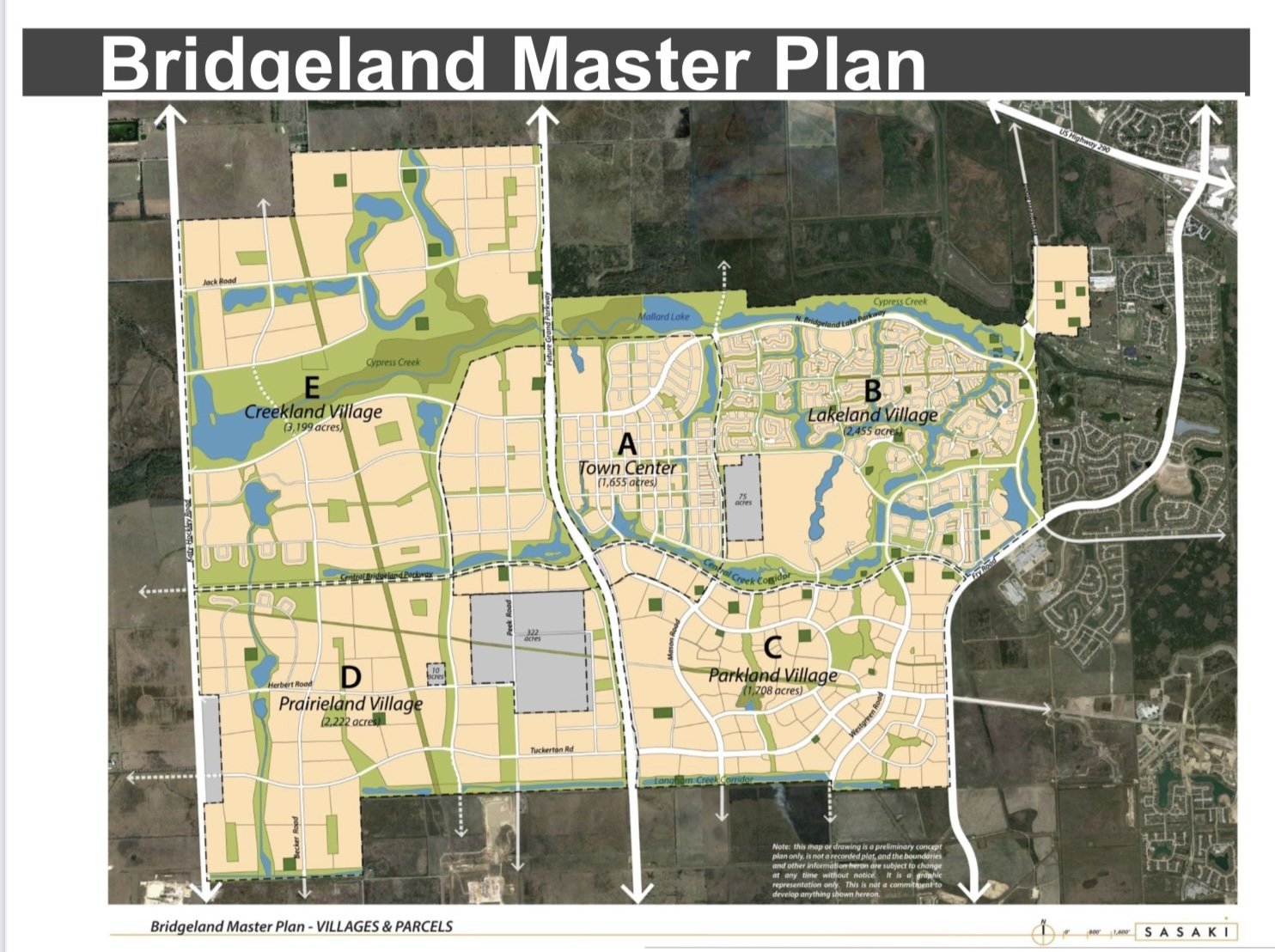
Development began in 2003 and is structured into four villages — Lakeland, Parkland, Prairieland, and Creekland — each phased to align infrastructure investment, residential absorption, and amenity delivery. A future 900-acre town center along the Grand Parkway anchors long-term commercial activation.
The defining feature of Bridgeland is disciplined sequencing — ensuring environmental infrastructure, open space, and vertical development evolve cohesively over a multi-decade horizon.

TND Neighborhood Lakeland Heights Village Center with 50,000 SF of Retail space- Planning in 2008
Parks and Landscape
Upon completion, Bridgeland will feature more than 3,000 acres of open space, including approximately 900 acres of interconnected lakes, 400 acres of parks, and 250 miles of integrated trails — ensuring that every home is located within a quarter-mile of accessible green space.
True to its name, the community is organized around an extensive lake network crossed by streets, bridges, and engineered culvert systems designed to manage regional water flows while maintaining visual continuity and environmental performance. Residents have access to non-motorized boating on Cypress Lake and Josey Lake, reinforcing the lakes’ dual role as infrastructure and amenity.
Within Josey Lake, a landscaped island includes a two-story birding tower connected by a pedestrian skybridge, offering panoramic views and interpretive programming that highlights native wildlife. The integration of environmental infrastructure, recreation, and public access exemplifies the community’s broader commitment to resilience, connectivity, and long-term livability.

